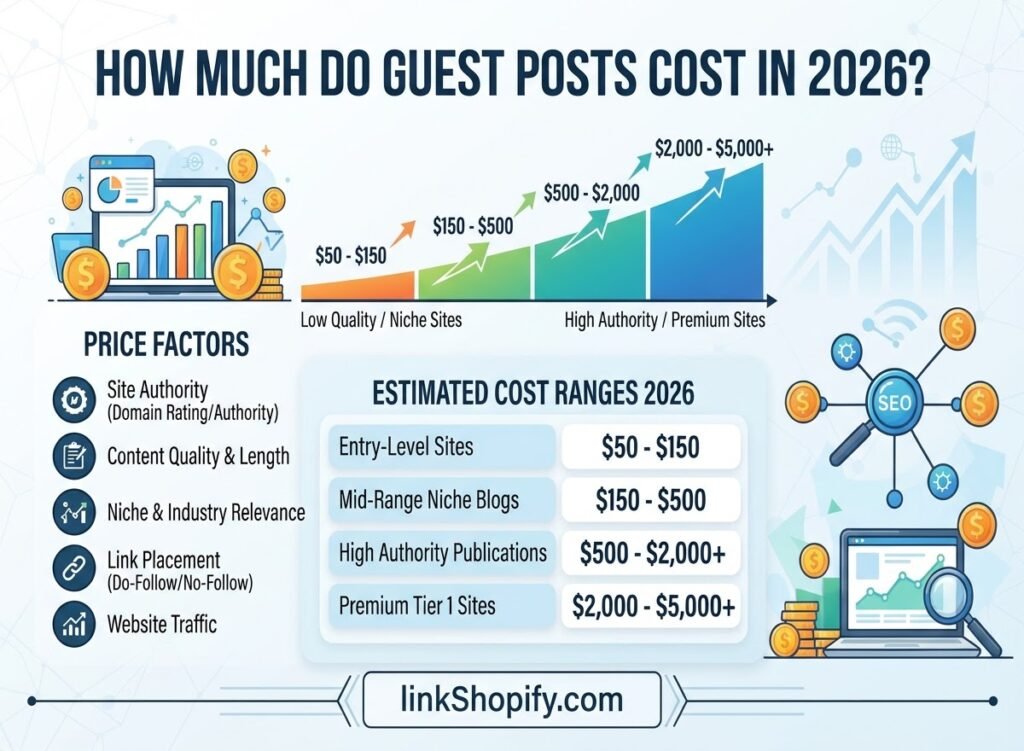
Answer: A guest post typically costs between $50 and $150 on a small site and $150 to $400 on a mid-authority site. High-authority sites (DR 70 and above) run from $500 to several thousand dollars. The final price depends mostly on the site’s authority, real traffic, niche, and link type.
The figures below are typical market ranges for the USA, UK, Australia, and Canada. Individual publishers set their own prices, so treat them as a guide, not a quote.
| Site authority (DR) | Typical price range | What you get |
| DR 20 to 40 | $50 to $150 | Small niche blogs, limited traffic |
| DR 40 to 60 | $150 to $400 | Established blogs with steady organic traffic |
| DR 60 to 80 | $400 to $1,000+ | Strong industry sites and magazines |
| DR 80+ | $1,000 to $5,000+ | Major publications and news-style sites |
Domain Rating (DR) from Ahrefs and Domain Authority (DA) from Moz are third-party metrics, not Google scores. Use them to compare sites, but never as the only factor.
Sites with stronger backlink profiles charge more, because a link from them passes more trust.
A site with 50,000 monthly visitors is worth far more than a site with a high DR and almost no traffic. Always check traffic by country. If you sell in the UK or Australia, a site whose visitors come from elsewhere is less useful.
Sensitive or competitive niches cost more. Finance, health, legal, crypto, and casino sites often charge 2 to 5 times as much as general lifestyle or business blogs because fewer publishers accept those topics.
A dofollow link usually costs more than a nofollow or sponsored link. Always check the link type before ordering.
Some publishers include the article. Others charge extra, commonly $50 to $150 for a professionally written post, or you can supply your own.
Standard delivery is often 3 to 7 days. Rush delivery can cost more.
Two links in one post, or a guarantee that the link stays live for a set period, can raise the price.
Sometimes, but be careful. A $20 post is often on a site that publishes anything for anyone. Warning signs include:
A small number of relevant, trusted links usually beats a large number of cheap ones.
Google’s spam policies say that buying or selling links that pass ranking credit can violate its guidelines. Google’s guidance is to mark paid or sponsored links with rel=”sponsored” or rel=”nofollow”. Many businesses still buy guest posts, and the risk depends on how you do it.
To keep risk low:
No one can promise rankings, and anyone who does should be treated with suspicion.
A simple way to plan:
Spend more on fewer, better links before you spend less on many weak ones.
You have three main options:
On LinkShopify, each listing shows its metrics, link type, and delivery time before you order, and publishers are manually checked before they are listed. Plans start at $49 per month.
Most guest posts cost between $100 and $500. Cheaper posts are usually on low-authority sites, and well-known publications cost much more.
They can be, if the site is relevant, has real traffic, and the post is useful to readers. A well-chosen link can bring both referral traffic and authority. Cheap links on irrelevant sites rarely help.
Links from trusted, relevant sites can support rankings alongside good content and a sound site structure. They are not a shortcut, and results vary.
If you do not have a writer, yes. A well-written article is more likely to be accepted and to stay live. If you have your own content, check each publisher’s quality rules first.
Most take 3 to 7 days after the article is approved. Some premium publications take weeks.
That depends on the seller. Choose a provider that offers a refund or replacement if the link is removed early.
Guest post pricing comes down to authority, traffic, niche, and link type. Decide your budget, set clear quality rules, and favour relevant sites with real readers over cheap, high-volume deals.
Ready to compare publishers? Browse the LinkShopify marketplace and filter by price, DR, traffic, and country.